2° Meeting nazionale TWC Italia
🕒 13 giugno, 00:00 - 14 giugno, 00:00
📍 Casale Falchetti, Roma, Lazio
🔗 https://mobilizon.it/events/1f53f993-bc88-4a44-b6db-ba4ac0da8196
Giacomo Leidi
Interested in tech work and technological autonomy. I happen to run bonfire.fishinthecalculator.me .
2° Meeting nazionale TWC Italia
🕒 13 giugno, 00:00 - 14 giugno, 00:00
📍 Casale Falchetti, Roma, Lazio
🔗 https://mobilizon.it/events/1f53f993-bc88-4a44-b6db-ba4ac0da8196
ANNUNCIAZIO' 📣🌳
Qualcunə sapeva che bolliva in pentola, ma finalmente con i Lecciofanti siamo usciti allo scoperto!
CHIAMIAMO IL #FEDIVERSO A RACCOLTA!
Stiamo costruendo un piccolo vivaio collettivo a #Pisa per combattere la desertificazione della città e del Monte, passando dalle decine alle centinaia di alberi piantati, ma ci servon soldini per l'irrigazione! 💧
Aiutateci donando qui! C'è anche un regalino per voi! 🎁
https://www.paypal.com/pools/c/9oPd2FIm3S
Preghiera di massima diffusione! 🌳🔁
Last year, the ability to declaratively provision OCI containers, networks and volumes was introduced in #guix ( https://guix.gnu.org/manual/devel/en/guix.html#index-oci_002dservice_002dtype ). This allows for managing OCI containers with the Shepherd and having them integrated and customizable via Guix code, see for example #gocix .
Many people are used to manage their OCI containers with docker compose but want to migrate to Guix OCI services to benefit from Guix rollbacks and further features.
https://codeberg.org/fishinthecalculator/guix-compose does exactly that, you run
guix compose import docker-compose.yml
and you get the corresponding Guix code to instantiate the same resources. You can just paste it in your configuration and you run it.
next steps could be running containers as transient Shepherd services and trying to parse @coopcloud recipes and output Guix code
Hi everyone! We’re excited to share some updates:
Bonfire 1.0.1 is out! 🎉
This release is all about making your social web experience livelier, more connected, and truly yours. It brings features like following hashtags, scheduled posts, dashboard widgets, and more. This is the very first delivery from the maintenance work funded by your incredible support. Thank you for helping us reach this milestone and keep Bonfire thriving!
For details about the release see our latest blog post: Bonfire 1.0.1: Building Momentum
What’s next for crowdfunding?
If you're an existing backer, the pledge manager is now open. Please keep an eye out for updates there so we can start preparing rewards for you.
The campaign is open again for the next month. With core maintenance funded, every new pledge (or increased pledge from existing backers) now goes directly toward our first stretch goal: federated groups. Support or share our extended campaign to help fund community-owned, cross-instance spaces for real collaboration and self-governance.
Bonus good news: Thanks to a new grant, end-to-end encrypted messaging in Bonfire is now funded and in development!
Thank you once again for being part of the Bonfire movement! Your feedback, support, and community spirit make all of this possible. If you have questions or want to get involved, reach out or come say hello at FOSDEM if you’re in Brussels at the end of January!
With gratitude,
The Bonfire Team
Fediverse Report – #142
More on Bonfire, which is currently doing a crowdfunding campaign (for an extensive look at Bonfire, see last week’s report):
One thing that strikes me about Bonfire’s approach, both to how they develop their software and how they run their crowdfunding campaign, is that they explicitly do not want to run a flagship server of Bonfire. Instead, they are heavily focused on the role of communities that can set up their own server. However, what that approach misses is that the concept of a community setting up their own fediverse server seems to be heavily tied to specific moments in time. Between 36 months and 30 months ago, over 120 new Mastodon servers have been started that have more than 100 active accounts. Between 30 months and now, 24 new Mastodon servers have been started that have more than 100 active accounts. For the most recent year this effect is even more pronounced, with 10 Mastodon servers started in the last year that have more than 100 active accounts.
This shows that the movement of starting a new fediverse server was heavily tied to the Mastodon migration effect that started after Elon Musk took over, in the fall of 2022. After that period, much fewer communities have started a new Mastodon server. This poses a challenge for the approach of Bonfire: the Bonfire Social software is now officially released in a 1.0 version, but there is not a single publicly accessible server that runs Bonfire. And sure, over time this will likely come and people will start to run a Bonfire Social server. But the momentum for people to start new fediverse servers has ebbed away for now. Hopefully, new software such as Bonfire can bring some of that energy back.
Mastodon has updated and simplified the roadmap of what they are working on, as the old version of the roadmap has not been updated for a while. Mastodon is currently working on three features:
Personally I’m confused on why giving admins control over the landing page of a Mastodon server is labeled as “Institution support”, and not just support for any Mastodon server. Mastodon, and the fediverse more broadly, has struggled for a long time with the concept of ‘server’. Servers are interchangeably seen as ‘just a way for people to access the fediverse network’ and ‘individual places of community in a wider social web’. While the second interpretation is how people want the fediverse to be understood, in practice it is often much closer to the first interpretation. Giving any server a way to customise the landing page, making it clearer why Mastodon server A is different from Mastodon server B, is a great way to push the network to a network of connected places. That Mastodon is only adding this customisation because of institutional support feels like even the Mastodon organisation itself has trouble sometimes to truly commit to the idea that Mastodon servers can be unique individual communities in a larger social network.
Features further down the line that Mastodon is exploring is the better support for private messages and moderation tools. More support for stuff like shared blocklists is highly needed, and I’m curious to see what comes out of it. Showing private messages as real messages and not have them show up in the feed is also long overdue. I’ve missed a fair number of private messages that way (apologies to everyone I’ve responded late to due to this), so its good to see that this eventually might change.
Mastodon is not alone in working on better moderation tooling for Mastodon and the fediverse. The Fedimod FIRES project by independent developer Emelia Smith also gives fediverse servers the option to share moderation information with each other. It is still in development, and Smith released the latest version this week, saying that she hopes this will be the final version before an 1.0 launch.
https://connectedplaces.online/reports/fediverse-report-142/

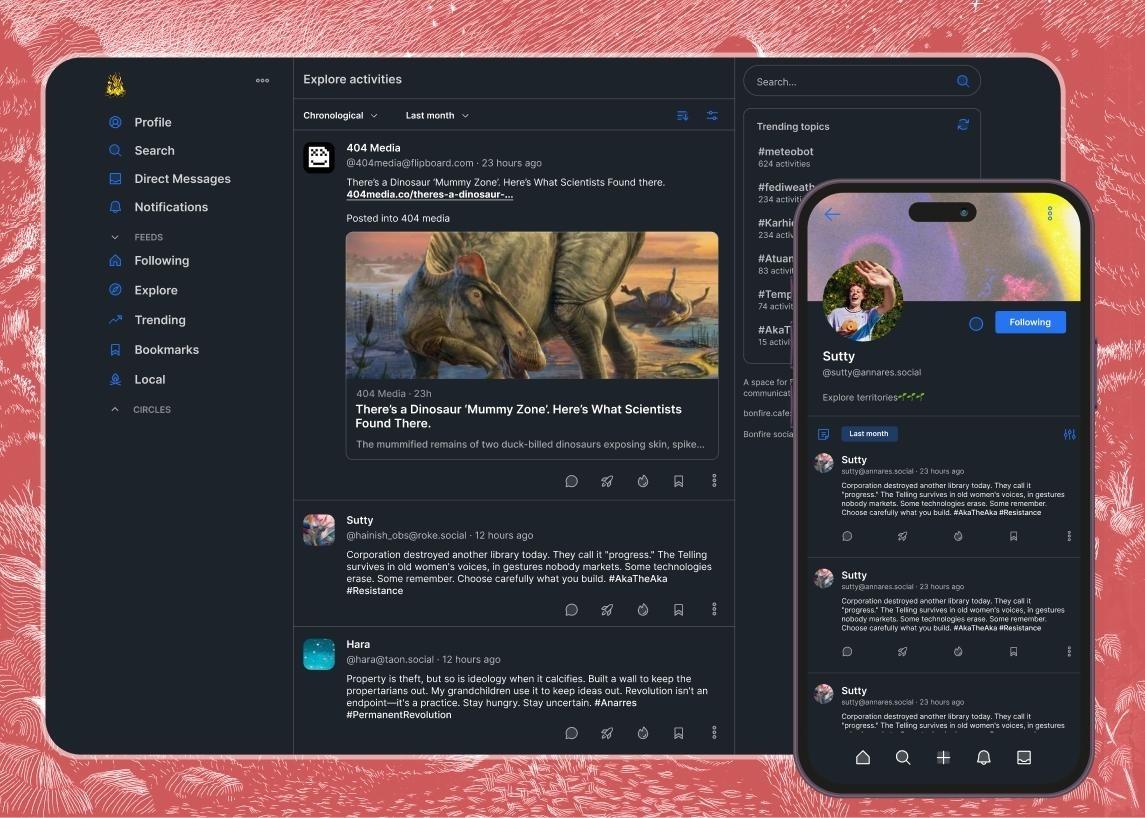
Bonfire 1.0 is out! Check it out, it has an awesome community and a lot of nice features. Also it officially supports #Guix as a hosting platform via an OCI service docs.bonfirenetworks.org/dep... .
They are also starting a crowd funding campaign, if you like the project, consider supporting the team!
https://indieweb.social/users/bonfire/statuses/115507615653471686
Bonfire Social 1.0 is live! A federated, community‑first social network built on the modular Bonfire toolkit, and it’s only the beginning.
It's time to go beyond microblogging and build apps for community organising, open science, mutual aid, and collective decision‑making. Let's take back the internet with open protocols, consent‑based governance, and portability by design.
Back the “last migration” from closed platforms to open networks: https://www.indiegogo.com/projects/bonfire/community?refcode=FVxjqI1kLUOhHXxqyrS6-g
1/2
Perfect example of why Guix just needs to include stock Linux and ditch Linux-libre: https://lobste.rs/c/mbtxry
New users have no idea why their wifi doesn't work and then detractors use it against us. Every Guix thread outside official channels since the beginning of the project has been dominated by this issue and it overshadows all the good things Guix does.
Ben due photo
So guix have lauched its fundraising campaign, So I urge all the #guix users to chime in and #nix users can also chime in because who wouln't want a good competitor :p, All I want is guix to flourish, More details here
https://guix.gnu.org/en/blog/2025/fundraising-campaign-to-sustain-gnu-guix/
📣 Bonfire Social 1.0rc3 just dropped!
This latest release puts data portability and anti-enshittification front and center.
Read what's new: https://bonfirenetworks.org/posts/bonfire-social-1-0rc3/
@civodul@toot.aquilenet.fr @khinsen@scholar.social @pjotrprins@mastodon.social @dthompson@toot.cat I think this is pretty much the point. To self host complex software stacks there will be always some kind of technical knowledge requirements, even stuff we might consider easy (such as the concept of domain names and DNS).
The point of projects like Fortino and Yunohost is to lower the bar as much as possible, in your example one could maybe look at logs through a web interface instead of having to grep stuff around.
In my experience there is a set of small organizations that have a strong need for a self managed infrastructure, maybe because they are climate justice orgs doing civil disobedience or labor unions, but for many reasons they struggle to keep volounteer highly technical people engaged enough to have a sustainable quality of service. So they end up using Big Tech, not because they want but because the tech usability bar is too high
well this is a cool project by @fishinthecalculator ! aims to combine guix, goblins, and hoot to make a yunohost-like application. https://fishinthecalculator.me/fortino.html
The next @spritely office hours will be held next week on 9/24. Meeting details available on our forum: https://community.spritely.institute/t/next-office-hours-on-9-24/766
Hope to see some of you there!
An update of the port of Shepherd to Spritely Goblins! https://spritely.institute/news/shepherd-goblins-update.html
Shepherd on Goblins RUNS! There's still some things to clean up but Juli Sims has been leading the effort with a lot of work also by David Thompson. There's examples of Goblins + Shepherd running a userspace Shepherd daemon... and even a demo of Goblins + Shepherd allowing for fleet orchestration!
The 2025 Fediverse Needs Assessment is open! If you run or moderate an online community, your feedback will guide the tools, training, and resources we focus on next year. See https://about.iftas.org/moderator-needs-assessment/ for details
#Fedimods#Moderators#FediAdmin#Moderation
http://about.iftas.org/moderator-needs-assessment
Back in the late 90s, pirates from Naples were printing pirated PS1 games and adding a little "disclaimer" on the CDs that said "we apologize to Sony, but we're unemployed".
🏳️🌈🏳️⚧️🇵🇸💻🌱
I'm looking for a single #room from the 1 of September, anywhere in #Brussels. I am a native Italian speaker and I fluently speak English. I work remotely for a software company.
💡I have been a #techworkers#organizer 🤖 and #climatejustice#activist 🌿 for the last 5 years and I really look forward to meet people that can introduce me to the Brussels #grassroot political scene.
🗓️ I have 11 years of coliving experience. I am able to take care of myself and to keep shared spaces clean and in order once I'm done using them. I love to spend time together but at the same time, I strongly value boundaries and alone time.
💕 I am looking for a community with empathy and good vibes.
I sometimes smoke but it's no problem smoking only outside of the house. Budget between 600 and 700, utilities included .
ChatGPT Is Still a Bullshit Machine
CEO Sam Altman says it's like having a superpower, but GPT-5 struggles with basic questions.
https://gizmodo.com/chatgpt-is-still-a-bullshit-machine-2000640488